At five inches, wide plank stops being a style choice and becomes an installation method. Glue plus nails, bigger expansion gaps, and a humidity problem.

Five inches is where wide plank stops being a style choice and becomes a different installation. At that width and above, flooring over a plywood or OSB subfloor needs glue in addition to nails, the expansion allowance at the walls gets substantially larger, and the seasonal movement that is invisible on a 2 1/4 inch strip floor becomes visible on every seam. None of that makes wide plank a bad idea in Middle Tennessee. It makes it a decision that has to be made with the installation method, not just the sample.
Standard strip flooring runs roughly 2 1/4 to 4 inches. Wide plank generally starts around 5 inches and goes up from there, and most of the look people are after in new Gallatin and Hendersonville construction lives between 5 and 7 inches.
Wood moves across its width far more than along its length. That is not a flaw, it is how the material works, and it is why the National Wood Flooring Association recommends holding a home between 30 and 50 percent relative humidity at 60 to 80 degrees Fahrenheit.
The movement per inch of width is roughly the same regardless of board size. What changes is where that movement ends up. On a strip floor, the total seasonal movement in a room is divided across a great many seams, so no single gap is visible. On a 7 inch plank floor, the same total movement is divided across less than half as many seams, so each one shows more than twice as much.
Middle Tennessee makes this worse than a brochure photographed in a stable climate suggests. Humid summers followed by months of dry forced-air heat is exactly the swing that wide boards amplify.
Glue and nails, not nails alone. For solid or engineered wide plank at 5 inches or wider over a plywood or OSB subfloor, the accepted method is nail-down plus a glue assist: a bead of adhesive on the subfloor between vapor-retarder runs, not a full glue-down. Nailing alone leaves wide boards free to move and squeak against the subfloor.
There is a subtler reason. Nails act like tent pegs on the tongue side of each board, so the board tends to expand in the direction the tongue faces rather than evenly. In rooms running more than about 20 feet in the direction of expansion, that accumulated one-way movement is what produces cupping and cracking.
A bigger expansion allowance. Commonly around 3/4 inch across the width of the room and roughly 1/4 inch along the length. That is more than a standard baseboard will cover on its own, which is why shoe molding or a taller baseboard needs to be part of the plan.
A flatter subfloor. A wide board is a rigid beam. Where a narrow strip conforms to a dip, a wide plank bridges it and rocks, and you hear about it every time someone walks across the room. Subfloor leveling is not an upsell on wide plank work, it is a precondition.
Real acclimation and moisture testing. Starting an installation is an acceptance that the material is acclimated and the subfloor has been tested. On wide plank, getting that wrong is not a subtle outcome.
Engineered deserves serious consideration at this width, and that is not a downgrade. The cross-laminated core resists exactly the dimensional change that makes wide solid boards move, which means the look survives our humidity swings with far less drama. The wood on the surface is the same species you picked.
Solid wide plank is absolutely doable in Middle Tennessee. It demands more: real acclimation, verified subfloor moisture, the glue assist, and a homeowner who runs a humidifier in winter and air conditioning in summer rather than closing the house up for three weeks in August.
If you want wide plank and you are not going to manage indoor humidity, choose engineered. That is the honest version of the advice.
One thing to check if you go engineered: the wear layer thickness, not the overall board thickness. A thick plank can carry a thin veneer, and the veneer is what determines whether the floor can ever be sanded.
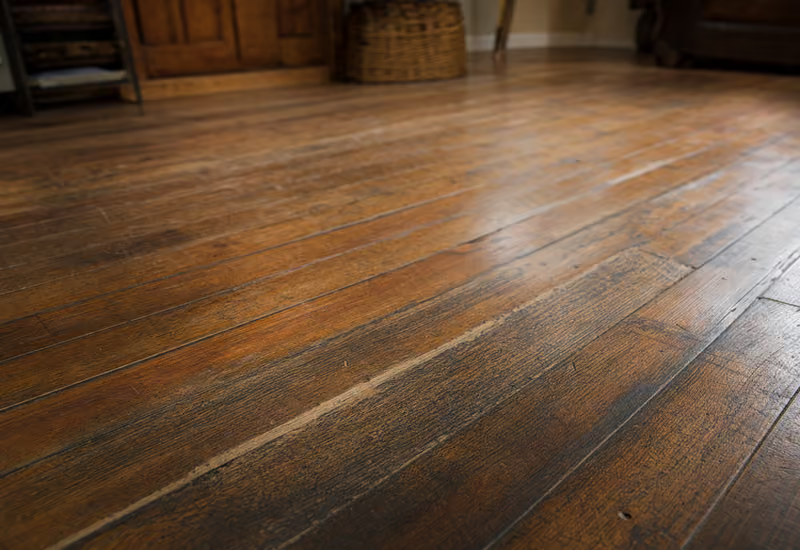
Reclaimed wide plank is a genuinely different product and worth understanding before you fall for a photo.
What you are buying is character, and character is not uniform. Nail holes, insect tracks, saw marks, checking and color variation are the point. If you want a consistent floor, reclaimed is the wrong material and no amount of sorting fixes it.
Thickness and width vary. Old material was milled to different standards, and remilling it costs yield. Expect a larger waste allowance than new wood.
Sourcing drives the schedule. Reclaimed is not a catalog item with a reorder button. Quantity matters, and running short halfway through a job is a real risk, so buy the whole floor plus a meaningful overage at once.
Metal. Reputable remillers scan for fasteners, but reclaimed material is why installers keep spare blades. Ask what the supplier does about it.
The look is excellent and it suits a lot of Middle Tennessee architecture. It is simply a sourcing project rather than a shopping trip, and the lead time should be in your schedule from the start.
Rooms that run long in the expansion direction. Above about 20 feet, directional movement accumulates. It can be managed, but a narrower board makes it a non-issue.
Houses that get closed up. A second home, a rental between tenants, or a family that travels for weeks in summer with the air conditioning off. Wide solid plank punishes that.
When you are matching an existing floor. If the rest of the house is 2 1/4 inch oak, a wide plank addition will not read as an extension of it. It will read as a different room, which is fine if intended and jarring if not.
Small rooms. Wide boards in a tight space mean few boards across, and the floor can read as oversized rather than generous.
When budget is the constraint. Wide boards require larger, older trees and produce more milling waste, so the material costs more, and the glue assist and subfloor prep add to the installation. If the budget is fixed, a better species or grade in a standard width usually produces a better-looking floor than a cheap wide plank.
What counts as wide plank flooring? Generally 5 inches and wider. Standard strip flooring runs about 2 1/4 to 4 inches, and most wide plank installations in this area fall between 5 and 7 inches.
Does wide plank hardwood gap more in winter? Yes, visibly. The total seasonal movement in a room is similar, but it is divided among fewer seams, so each gap is wider. Holding indoor humidity between 30 and 50 percent through heating season is the most effective control.
Can wide plank be nailed down like regular flooring? Not on its own at 5 inches and up over plywood or OSB. The accepted method adds a glue assist to the nail-down installation to bond the boards to the subfloor and prevent movement and squeaks.
Is engineered wide plank as good as solid? For wide formats in a humid climate, engineered often performs better, because the cross-ply core resists the dimensional change that makes wide solid boards move. Check the wear layer thickness, since that determines whether it can be refinished.
How much extra should I order for reclaimed wide plank? More than you would for new material, because remilling yields vary and you will set aside boards. Order the full floor plus a meaningful overage in one purchase, since reclaimed stock is not reliably reorderable later.
Will wide plank work over my crawlspace? It can, provided the crawlspace is dry with proper ground cover and ventilation, and the subfloor reads acceptably on a moisture meter. Ground moisture rising into the subfloor affects wide boards more visibly than narrow ones.
A three inch sample tells you about color. It tells you almost nothing about how a 7 inch board will read in your room, which is the entire reason the showroom exists.
Copeland Hardwood Floors installs solid hardwood, engineered hardwood and unfinished hardwood, and handles subfloor preparation and installation across Middle Tennessee. Our showroom is at 610 Airport Road in Gallatin.
We serve Gallatin, Hendersonville, Nashville, Brentwood, Franklin, Mt. Juliet, White House, Lebanon, Bethpage, Millersville, Madison and Goodlettsville.
Call (615) 451-0723 or contact us. Beauty That Lasts a Lifetime.
Related reading: Oak, Hickory, Maple or Walnut? Choosing a Hardwood Species and Grade, Engineered vs. Solid Hardwood in Gallatin, and Why Hardwood Floors Cup and Gap in Middle Tennessee.