Engineered or solid hardwood for your Gallatin home? The honest answer depends on your subfloor, not your budget. A Middle Tennessee flooring contractor explains.
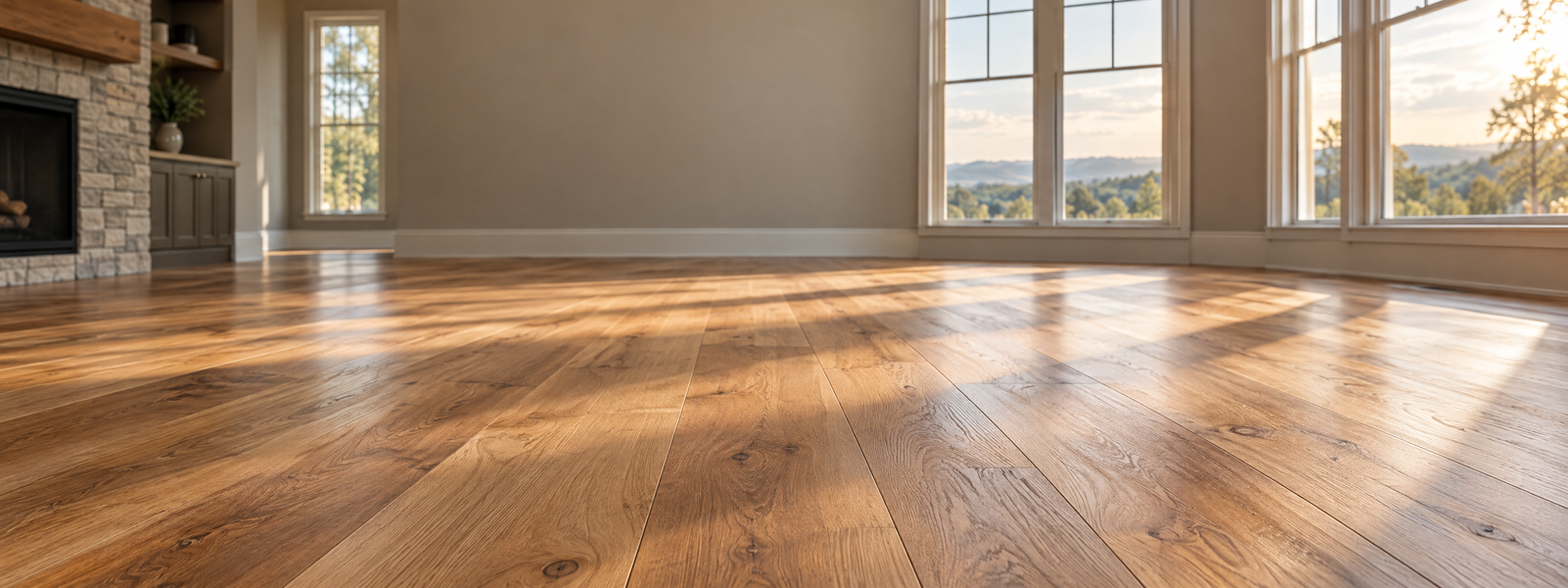
For most Gallatin homes built over a crawlspace or basement, solid hardwood is the right call, and for homes built on a concrete slab, engineered hardwood is usually the only correct choice. The decision is driven by what is under the floor, not by budget or by which one is "real wood." Both are real wood. The difference is how the board is built and where that construction can safely live.
That answer surprises people, because most of what gets written about engineered flooring treats it as the cheaper compromise. It is not. A well-built engineered floor can cost more per square foot than solid oak and can outlast it in the wrong location. The mistake homeowners make is not choosing the cheaper product. It is choosing the product that cannot handle the room.
Here is how we walk Gallatin, Hendersonville and Nashville homeowners through it.
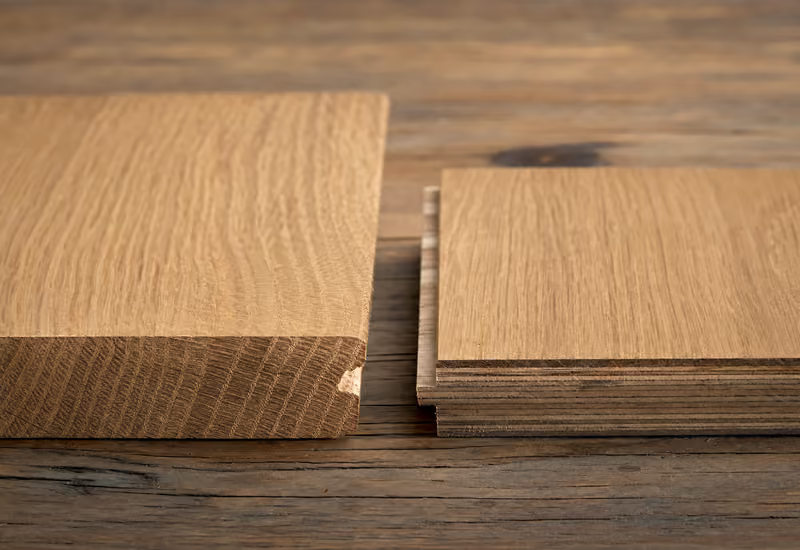
Solid hardwood is one piece of wood, milled from a single board, typically 3/4 inch thick. Every bit of it is the species you chose. Because it is solid, it expands and contracts across its full thickness as humidity changes, and it can be sanded down many times over its life.
Engineered hardwood is a real hardwood top layer bonded to a multi-ply core, usually plywood or high density fiberboard. The plies are cross-layered, meaning each one runs perpendicular to the one above it. That cross-lamination is the whole point: it fights the seasonal movement that makes solid wood cup, gap and crown.
So engineered flooring is not fake wood. The surface you walk on, sand and stain is the same oak, hickory or walnut. What changed is the engineering underneath it.
Engineered, almost always. Solid hardwood cannot be nailed into concrete, and gluing 3/4 inch solid wood directly to a slab invites failure as slab moisture migrates upward into the boards.
This matters more in Sumner County every year. A large share of the new construction going up around Gallatin, Hendersonville and out toward Mt. Juliet sits on slab, and so do most of the finished basements and bonus rooms homeowners are converting. Engineered flooring can be glued down or floated over a slab with a proper vapor barrier, and the cross-ply core tolerates the residual moisture that concrete gives off for years after it is poured.
We test slab moisture before we quote any of this work. A slab that reads too high is not a reason to give up on wood, but it is a reason to change the installation method, and finding that out after the floor is down is expensive.
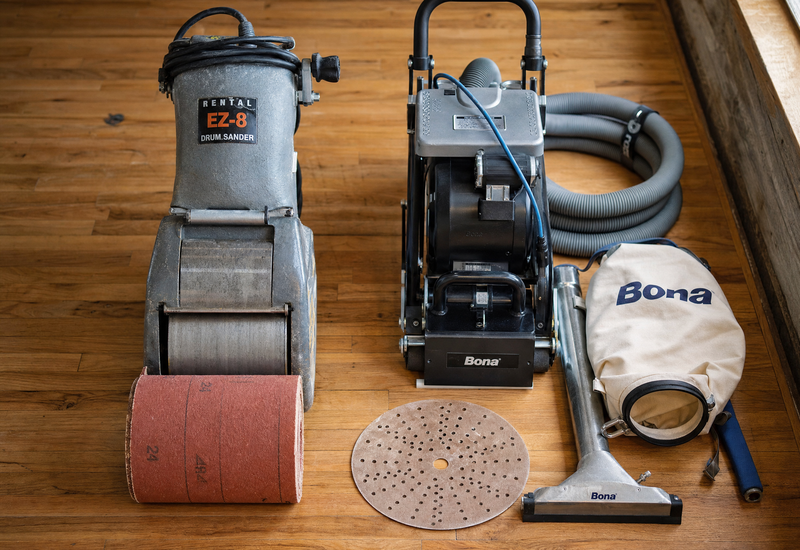
Yes, if the wear layer is thick enough, and this is where most online advice gets it wrong. The National Wood Flooring Association runs a Refinishable certification program with published minimums: 3.2 mm (4/32 inch) of wear layer for unfinished engineered flooring, and 2.5 mm (3/32 inch) for factory finished and for sculpted or distressed products measured at the lowest point. The NWFA Sand and Finish Guidelines put it bluntly: in general, if the wear thickness is less than 3/32 inch, the floor should not be sanded.
The expensive surprise here is that total thickness and wear layer thickness are different numbers. A 12 mm engineered board sounds substantial. If that board carries a 0.6 mm veneer, you own a floor that can never be sanded, only recoated, and one deep gouge becomes a board replacement instead of a repair.
When you shop engineered flooring, ignore the overall thickness on the box and ask one question: how many millimeters is the wear layer. If the answer is not on the spec sheet, that tells you something too.
Wide plank flooring is one of the most requested looks we see in Gallatin and in the Brentwood and Franklin remodels we take on. The physics are unforgiving: the wider the board, the more absolute movement it goes through with every seasonal humidity swing. A 7 inch solid plank moves more than twice as much across its face as a 3 inch plank in the same room.
That does not make wide solid plank impossible. It makes acclimation, subfloor moisture testing and humidity control non-negotiable, and it makes engineered a genuinely better performer for the look. If wide plank is the goal, engineered is not the compromise. It is the upgrade.
We would rather talk you out of the wrong floor than install it, so here is the honest counter-position.
Skip engineered when you are restoring an older Gallatin or Nashville home with existing solid oak. Matching new engineered boards into a solid floor creates a thickness difference and a wear behavior difference that will show up over time. Matching solid to solid is cleaner, and it is work we do constantly.
Skip engineered when you want a truly seamless, bevel-free floor. Most engineered products are factory finished with micro-bevels between boards. If you want the flat, continuous surface that only comes from sanding and finishing the floor in place, solid unfinished hardwood is the path.
Skip engineered when the wear layer is thin and the house is busy. If you have three kids, two dogs and a plan to stay twenty years, a 2 mm veneer is a false economy. Buy solid, or buy engineered with a wear layer that meets the NWFA refinishable threshold.
And skip solid hardwood when the room is below grade, over a slab, or over radiant heat. No amount of craftsmanship makes that combination work long term.
Most of the houses we work in around Sumner County are a mix. The main level sits over a crawlspace and takes solid oak beautifully. The finished basement sits on slab and needs engineered. The bonus room over the garage has its own temperature swings and often does better with engineered as well.
Running two different products in one house is normal, and it is not a design problem. With on-site sanding and custom stain matching, a solid floor upstairs and an engineered floor downstairs can be finished to read as one continuous material. That is a large part of what we do, and it is why we keep both in the showroom at 610 Airport Road rather than pushing one category.
Is engineered hardwood cheaper than solid hardwood?Not necessarily. Entry level engineered products with thin veneers are cheaper than solid oak. Premium engineered flooring with a thick sawn wear layer often costs more than solid, because you are paying for both the hardwood surface and the stable core beneath it.
How long does engineered hardwood last?It depends on the wear layer. A floor with a 4 mm or thicker wear layer can be sanded multiple times and last for decades. A floor with a sub 2 mm veneer can be recoated but not sanded, which shortens its useful life considerably.
Can I put solid hardwood in my basement?We do not recommend it. Below grade spaces carry moisture from the surrounding soil and the concrete itself, and solid wood responds to that moisture by cupping and eventually delaminating from the subfloor. Engineered flooring is built for this.
Does engineered hardwood add value like solid hardwood does?Buyers and appraisers in Middle Tennessee generally treat quality engineered wood as hardwood, because it is hardwood on the surface. What affects value is whether the floor looks good and has life left in it, not the construction of the core.
What is the best plank width for a Gallatin home?There is no single answer, but anything above about 5 inches deserves a conversation about construction. Wide plank in engineered form is more forgiving of our humidity swings than wide plank in solid form.
Can engineered hardwood go over radiant floor heat?Yes, and it is the preferred option. The cross-ply core handles the repeated heating and cooling cycles far better than solid wood does. Always confirm the manufacturer approves the specific product for radiant applications.
The right answer depends on your subfloor, your plank width, how long you plan to stay, and how the room is used. That is a ten minute conversation, not a guess.
Copeland Hardwood Floors has been installing solid hardwood and engineered hardwood across Middle Tennessee for decades, and our showroom at 610 Airport Road in Gallatin carries both so you can see and feel the difference before you commit. We serve Gallatin, Hendersonville, Nashville, Brentwood, Franklin, Mt. Juliet, White House, Lebanon, Bethpage, Millersville, Madison and Goodlettsville.
Call (615) 451-0723 or contact Copeland Hardwood Floors for a free estimate. Beauty That Lasts a Lifetime.
Related reading: Prefinished vs. Site-Finished Hardwood and How Long Do Hardwood Floors Last? A Middle Tennessee Homeowner's Guide.