Winter gaps and summer cupping are normal in Middle Tennessee. Sanding a cupped floor is the mistake that turns a seasonal problem into a permanent one.
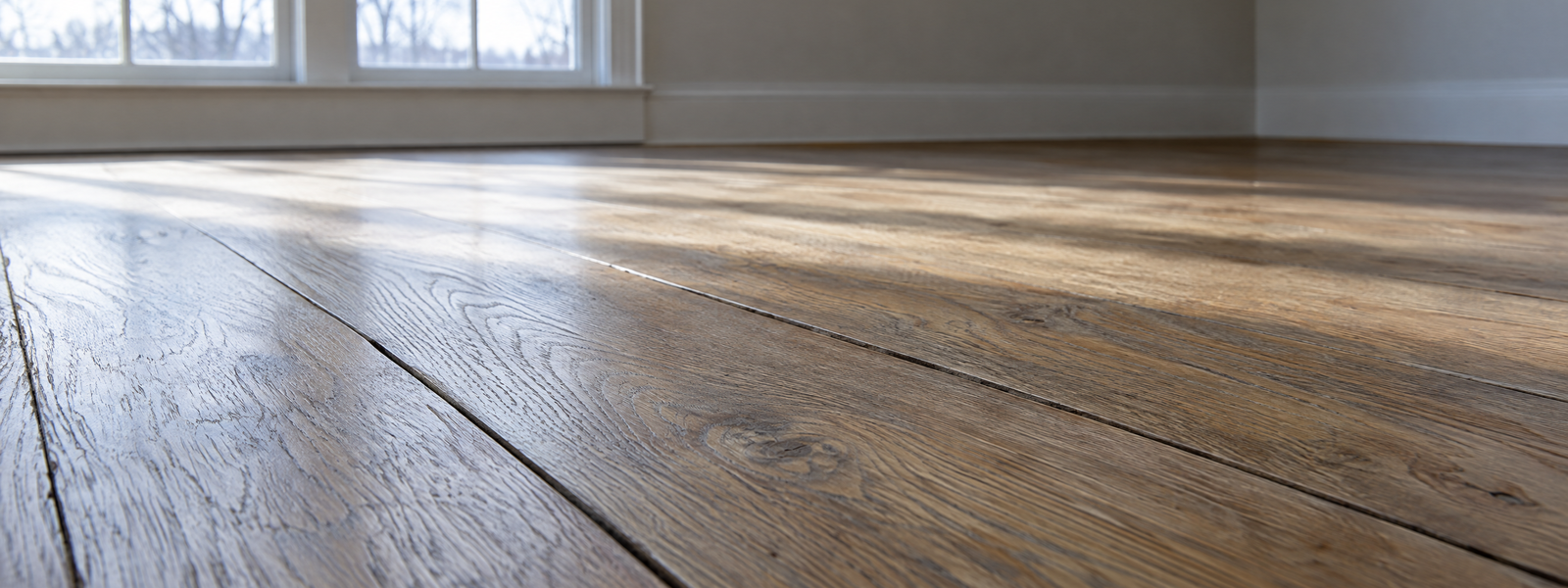
Most cupping and gapping in a Middle Tennessee home is seasonal and will correct itself. Wood floors here swell in our humid summers and shrink in dry, forced-air winters, and that movement is normal. The expensive mistake is sanding a floor while it is still cupped. When those boards dry out and flatten in the spring, the sanded high spots become permanent low spots, and you own a crowned floor that no amount of finish will fix.
That is the single piece of advice we most wish homeowners had before they called someone. It is also the reason we will sometimes tell you to wait three months instead of scheduling work.
Wood is hygroscopic. It absorbs moisture from the air when humidity rises and releases it when humidity falls, and it changes dimension as it does. This never stops. It is not a defect, it is the material.
The National Wood Flooring Association recommends keeping the interior environment between 30 and 50 percent relative humidity and 60 to 80 degrees Fahrenheit for wood floors to perform properly. Inside that band, seasonal movement is small enough to be invisible.
Middle Tennessee makes that band hard to hold. Nashville averages roughly 70 percent relative humidity across the year, running near 84 percent in the early morning and dropping to about 53 percent by mid-afternoon. Summer here is genuinely humid. Then heating season arrives, forced air runs for months, and indoor humidity in a Gallatin or Hendersonville house can fall well below 30 percent.
The scale of that swing is easy to underestimate. NWFA's own example runs the numbers on a 5 inch red oak plank subjected to a 30 percent humidity change: roughly 0.088 inches of movement per board. Across a 10 foot room, that adds up to more than 2 inches of cumulative movement. Spread across every seam in the floor, it is invisible. Concentrated in one place, it is a problem.
Cupping is when board edges rise higher than the center, creating a subtle washboard feel underfoot. It means the bottom of the board is wetter than the top. In our climate, this usually appears in late summer, or any time moisture is coming from below.
Gapping is space opening between boards. It means the wood has given up moisture and shrunk. This peaks in January and February in most Middle Tennessee homes, and it is the most common thing homeowners call about.
Crowning is the opposite of cupping: the center of each board sits higher than its edges. Crowning is almost never caused by weather alone. It is usually what happens when a cupped floor was sanded flat before it dried out.
That last one is the whole point of this article. Cupping and gapping are usually temporary. Crowning caused by premature sanding is permanent, and the repair is a full resand of the entire floor after it has been allowed to stabilize, if the floor has enough thickness left to survive it.
Ask three questions.
Is it the whole floor or one area? Uniform, gradual change across an entire room follows the season. A single cupped patch near a dishwasher, a refrigerator line, an exterior door or a bathroom is a leak until proven otherwise, and that is urgent.
Does it follow the calendar? Gaps that appear in January and close by May are the floor breathing. Gaps that are still there in July are not seasonal.
Is the crawlspace dry? This is the Middle Tennessee specific one. A large portion of the older housing stock around Gallatin, Bethpage, White House and the older Nashville neighborhoods sits over a crawlspace. A crawlspace with poor ground cover, standing water, or blocked ventilation pushes moisture up into the subfloor continuously. Floors above it cup regardless of what the thermostat says. If you have persistent cupping, look under the house before you look at the floor.
In winter, add moisture. A whole-house humidifier tied into the HVAC system is the real fix. Portable units help in a single room. The goal is holding above 30 percent relative humidity, not achieving a specific comfort feel.
In summer, run the air conditioning. Air conditioning dehumidifies as a side effect, and that is often enough. Homes that get closed up while owners travel for weeks in August are the ones that come back to cupped floors.
Check the crawlspace. Proper ground cover and adequate ventilation or encapsulation solve more flooring problems than any flooring product does.
Do not put a fan or a heater directly on a cupped floor. Drying the top surface faster than the bottom makes the problem worse and can split boards.
Wait before you sand. A cupped floor that is drying normally should be allowed to return to flat on its own. Depending on the season and the severity, that can take a few weeks to a few months. Only after it is flat and stable should anyone sand it.
We do not want to talk anyone out of a call that needs to happen. Get someone out quickly if:
Water damaged hardwood is repairable more often than people expect. We have replaced water damaged boards and then sanded and refinished the surrounding floor so the repair disappears entirely, which is generally a better outcome than replacing an entire floor. The variable is how quickly the moisture source gets stopped.
Largely, yes, and this is where a contractor earns their keep before a single board goes down.
Proper acclimation means bringing the flooring into the actual house, at normal living temperature and humidity, and letting it reach equilibrium before installation. Rushing this is the most common cause of a floor that gaps badly in its first winter. Exotic species need even longer, which is why we plan extended acclimation periods for materials like Brazilian cherry, tigerwood, acacia and teak.
Moisture testing the subfloor matters just as much. A slab or a wood subfloor that reads too high will telegraph that moisture into the finished floor for years. Vapor barriers, subfloor leveling and the right installation method for the conditions are not upsells. They are the difference between a floor that moves invisibly and one that does not.
Are gaps between hardwood floor boards normal in winter?Yes. In Middle Tennessee, thin gaps that appear during heating season and close again by late spring are normal seasonal shrinkage. Gaps wide enough to catch a dime, or gaps that persist through summer, are worth having evaluated.
Will a cupped hardwood floor go back to flat on its own?Usually, if the moisture source is removed and the floor is allowed to dry slowly. Do not accelerate it with heaters or fans aimed at the surface, and do not sand it until it has been flat and stable for a sustained period.
What humidity should I keep my house at to protect hardwood floors?The NWFA recommends 30 to 50 percent relative humidity with temperatures between 60 and 80 degrees Fahrenheit. A whole-house humidifier in winter and normal air conditioning in summer will hold most Middle Tennessee homes inside that range.
Can you repair just the damaged boards instead of the whole floor?Often yes. Individual boards can be replaced and blended with stain matching, then the surrounding area sanded and refinished so the repair is not visible. Whether that works depends on the species, grade and age of the existing floor.
Why is my floor cupping when there is no leak?Check the crawlspace. Ground moisture rising into the subfloor is the most common non-leak cause in this region, and it affects the whole room rather than one spot.
Does engineered hardwood cup and gap too?It moves far less, because its cross-layered core resists dimensional change. It is not immune, and engineered floors over a wet slab or a damp crawlspace can still cup.
If your floor is moving and you are not sure whether it is the season or a problem, that is exactly the call we like to get. Sometimes the answer is that you should wait until April, and we will tell you so.
Copeland Hardwood Floors handles hardwood repair, floor restoration and refinishing across Gallatin, Hendersonville, Nashville, Brentwood, Franklin, Mt. Juliet, White House, Lebanon, Bethpage, Millersville, Madison and Goodlettsville. Our showroom is at 610 Airport Road in Gallatin.
Call (615) 451-0723 or contact us for an evaluation. Beauty That Lasts a Lifetime.
Related reading: Engineered vs. Solid Hardwood in Gallatin and Restoring Hardwood Floors in Nashville Homes: When to Refinish, Repair, or Replace.