Adding hardwood to a room and want it to match? Here is what determines whether a match works, and the one approach that guarantees it.
Quick answer: An invisible match between brand-new wood and an existing floor is rarely possible on the first day, because old wood has changed color over years of light exposure and new wood has not. A very close match is usually achievable, and a genuinely seamless one almost always is, but only through one route: sand and refinish the old floor and the new wood together, as a single floor, so both receive the same stain and finish at the same moment. Everything else is an approximation. The approximations are often good enough, and we will tell you honestly which situation you are in before you commit.
This comes up constantly. You are pulling carpet out of two bedrooms and the hallway is already oak. It is also the deeper companion to our guide for Brentwood and Franklin hardwood floors. You are adding on. A leak destroyed part of the living room. The question is always the same: will anyone be able to tell?
Here is what determines the answer.
Species. Red oak and white oak are different woods with different grain and different undertones. Red oak carries a pink cast, white oak a browner, greener one. Stain does not erase that. Hickory, maple, and walnut are further apart still. Identifying the existing species correctly is step one, and it is not always obvious under an old finish.
Cut. Plainsawn, riftsawn, and quartersawn boards from the same tree look different. Plainsawn oak shows the wide cathedral grain most people picture. Quartersawn shows tight straight lines and ray flecks. Mixing cuts is visible even when the species matches.
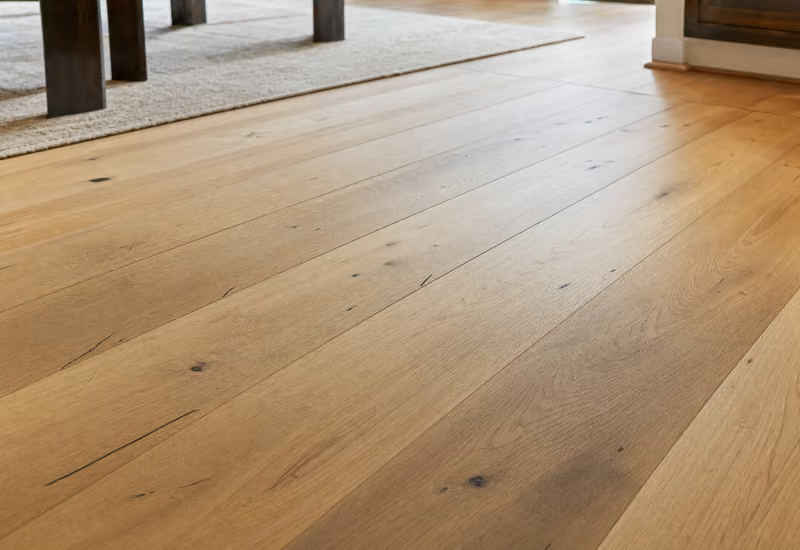
Grade. Grade describes how much natural character the boards carry: knots, mineral streak, color variation. A clear-grade floor next to a character-grade floor reads as two different floors regardless of stain. One customer told us the grade-2 hickory they chose had "a lot of color and knots," which is exactly the kind of detail that has to be matched deliberately rather than assumed.
Plank width and thickness. Width is obvious to the eye. Thickness matters underfoot, because a height difference at the seam is something you feel and eventually trip on.
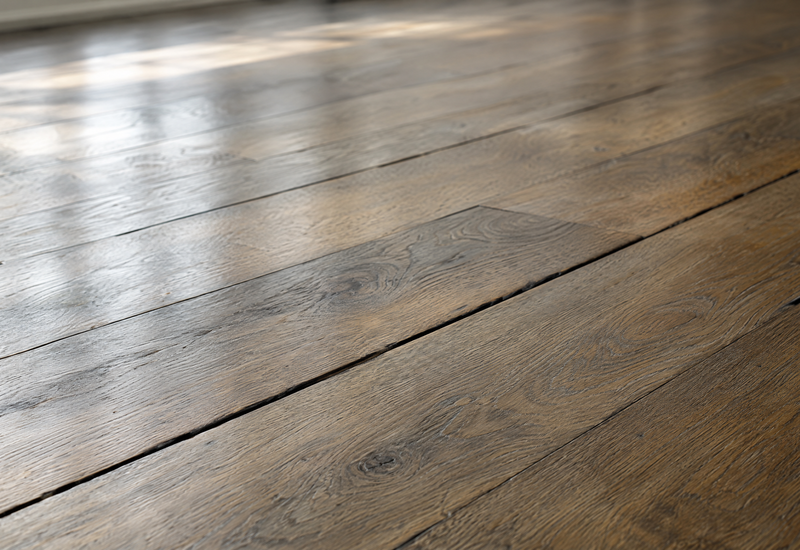
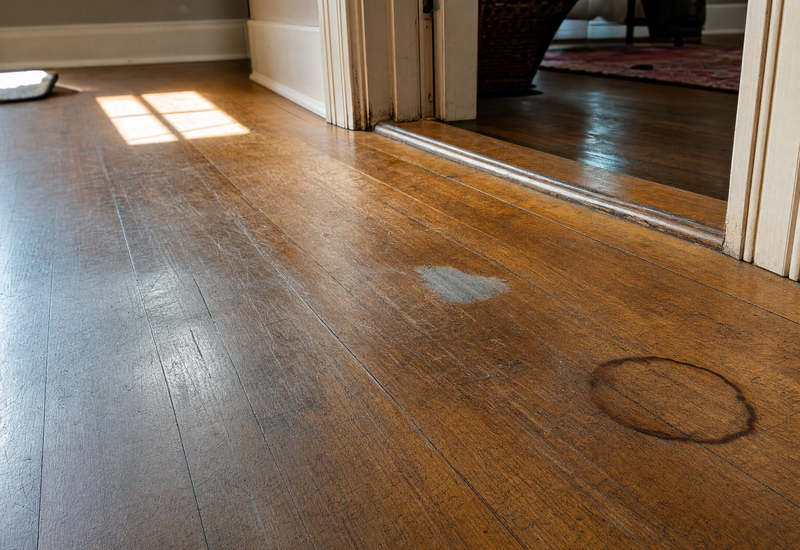
Age and oxidation. This is the variable people forget, and it is the reason a same-day match usually fails. Wood darkens and shifts color as it ages and takes light. Red oak ambers. Cherry and walnut change dramatically. New boards of the identical species and grade will read lighter and cooler than the twelve-year-old floor beside them, even before any stain is applied. Given time and light, they drift toward each other.
Existing finish. An old floor finished in oil-based polyurethane has a warm amber tone baked in. A water-based finish is clearer. Hardwax oil looks different again. Matching the finish chemistry matters as much as matching the stain color.
The middle option is the honest answer most of the time, and it is also the more expensive one, because you are refinishing the whole floor rather than just the new part. Learn more about the process through our hardwood floor refinishing service. We say so up front rather than after.
One customer described exactly this scenario: we replaced their water-damaged hardwood and then "sanded and refinished ALL of the hardwood flooring in our house to match." That is the approach that produces a floor with no story to tell.
If you are not refinishing everything, the match depends entirely on finding material that fits. That means identifying the species and cut, matching the grade and width, and then locating it, which for an older floor can mean a discontinued profile. A planned custom hardwood installation starts with those details rather than treating them as an afterthought.
This is the part that separates flooring companies, and it is the thing our customers bring up most often without being asked. One wrote that we were "the only Hardwood Flooring Company that took the time to find flooring to match an existing floor in my home." Another had an additional room done that "perfectly matched the rest of the house." A third had two carpeted bedrooms converted to hardwood that "matched my existing hardwood perfectly."
We keep raw hardwood, prefinished planking, trim, and transitions in stock at the Airport Road location, which shortens the search considerably compared with ordering blind from a catalog.
There is no barcode on your floor. Matching means applying candidate stains to the actual wood, in your actual house, and looking at them next to the existing floor before anyone commits. Our stain and finish options service uses on-floor sampling to guide that decision.
We apply stain samples directly onto the sanded floor rather than asking you to judge from a catalog chip. If a standard color is not quite right, we mix custom blends until it is. Where a deeper, richer color is the goal, water-popping opens the grain so the stain takes more fully.
Two things people underestimate:
Light changes everything. A sample that matches under showroom lighting can miss badly in a north-facing room at four in the afternoon. Samples belong in your house, on your floor.
The finish coat shifts the color. Oil-based polyurethane adds amber warmth that a water-based finish does not, and hardwax oil behaves differently again. The stain is only part of the final color. Judging a match from stain alone is how people end up with a floor that is close but wrong.
This takes time, and it should. Matching should never be rushed.
Sometimes not matching is correct.
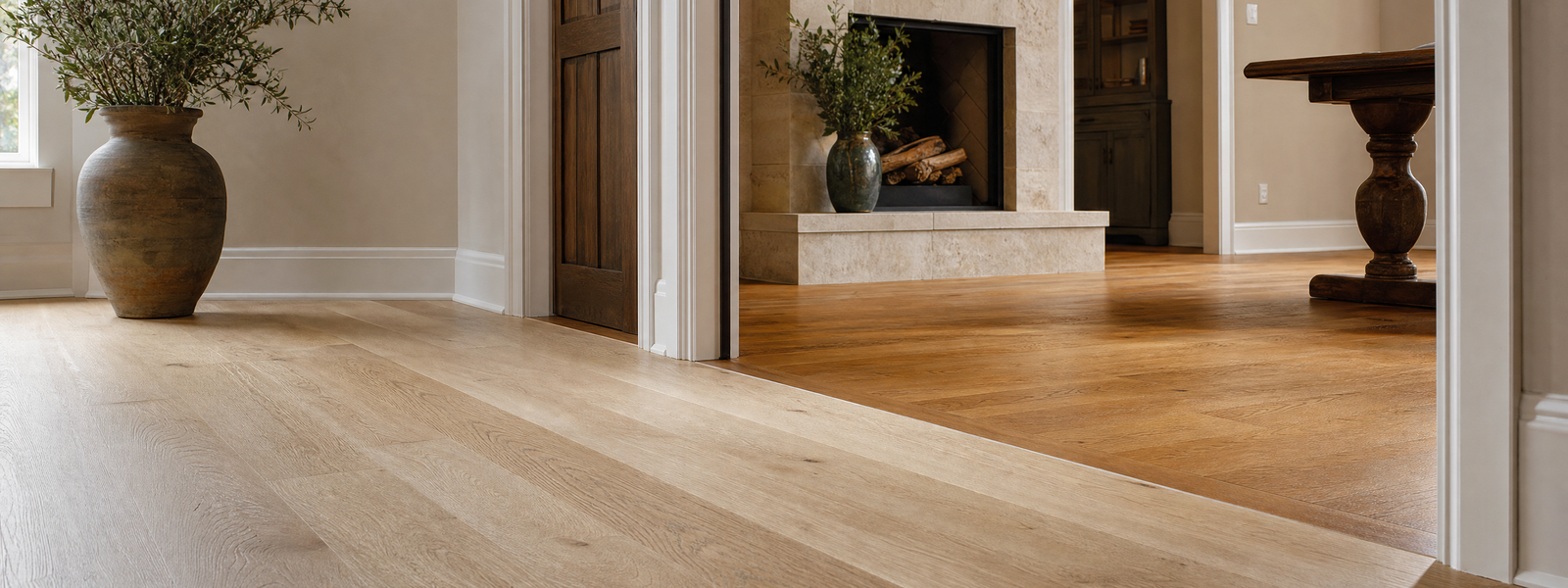
If the floors sit at different heights, if one area is engineered over slab and the other is solid over a crawlspace, if the existing floor has very little sanding life left, or if you genuinely like the idea of a different wood in a different room, a clean transition at the doorway is a design decision rather than a compromise. A well-placed threshold reads as intentional. A failed match reads as a mistake.
Worth checking before you plan anything. Every refinishing removes material. A solid floor that has been sanded four or five times over decades may not have enough thickness above the tongue for another pass, and an engineered floor with a thin wear layer may have none at all.
If the existing floor is at the end of its sanding life, matching new wood to it is building on a foundation with a short remaining lifespan. In that case the conversation changes to replacement, phased over time if that suits the budget better. We would rather have that conversation at the estimate than two years later.
Can new hardwood be matched perfectly to an existing floor?On day one, rarely, because old wood has changed color with age and light while new wood has not. A very close match is usually achievable. A truly seamless match comes from installing the new wood and then sanding and refinishing the entire floor together so everything takes the same stain and finish at once.
Will new hardwood eventually match the old floor on its own?It gets closer. Wood continues to change color with light exposure, so new boards of the same species and grade drift toward the older floor over months and years. How close it gets depends on species. Red oak ambers noticeably. It is a real effect, not a guarantee.
Do I have to refinish my whole floor to add hardwood to one room?Not necessarily. If the new area is not in the same sightline as the existing floor, a sourced match finished on its own is often fine. If the rooms connect and you want it to look original, refinishing everything together is the only approach that gets there.
How do you match the stain on an old hardwood floor?By applying candidate stains directly to the sanded floor in your own home, letting them cure, and comparing them against the existing wood in that room's light. If no standard color is right, we mix custom blends. The finish chemistry matters as much as the stain, since oil-based polyurethane adds amber that water-based finishes do not.
Can you match a discontinued hardwood floor?Often, yes. It depends on identifying the species, cut, grade, width, and thickness correctly and then locating material that fits. We keep raw hardwood, prefinished planking, and trim in stock in Gallatin, which shortens the search compared with ordering sight unseen.
What if my floors are different heights?A transition strip at the doorway is the standard answer, and it is a legitimate design choice rather than a failure. Height differences at a seam are something you feel underfoot and eventually catch a toe on, so forcing a flush match across mismatched thicknesses is not worth it.
If you are planning an addition, pulling carpet, or repairing damage, the fastest start is a photograph of the existing floor and, if you have one, a spare board or a piece from a closet. Call Copeland Hardwood Floors at (615) 451-0723 or visit 610 Airport Rd, Gallatin, TN 37066, and we will tell you honestly how close a match we can get and what each route costs. If damage is part of the project, explore our approach to hardwood repair.
We serve Gallatin, Hendersonville, Nashville, Franklin, Brentwood, Mt. Juliet, Lebanon, White House, Goodlettsville, Madison, Millersville, and Bethpage.
Beauty that lasts a lifetime. Request a free quote today.