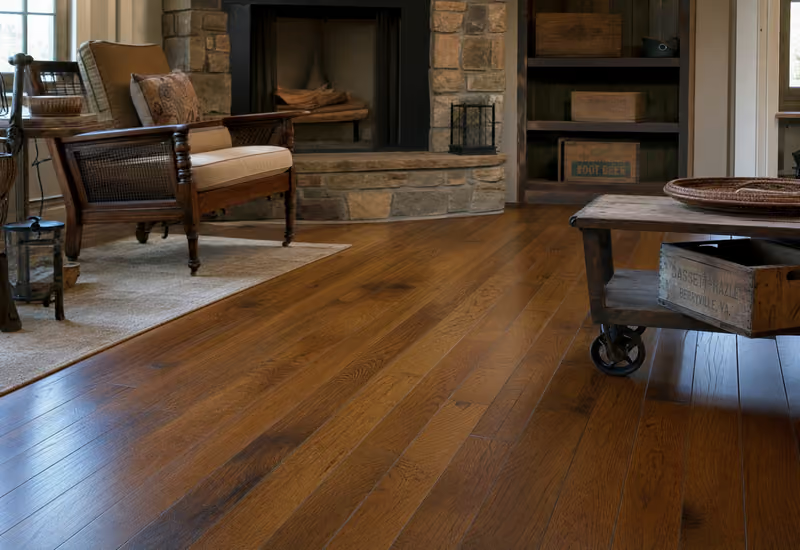
Red oak, white oak, hickory, maple or walnut? Why Janka hardness is the wrong way to pick a floor, and what character grade actually means. Gallatin, TN.
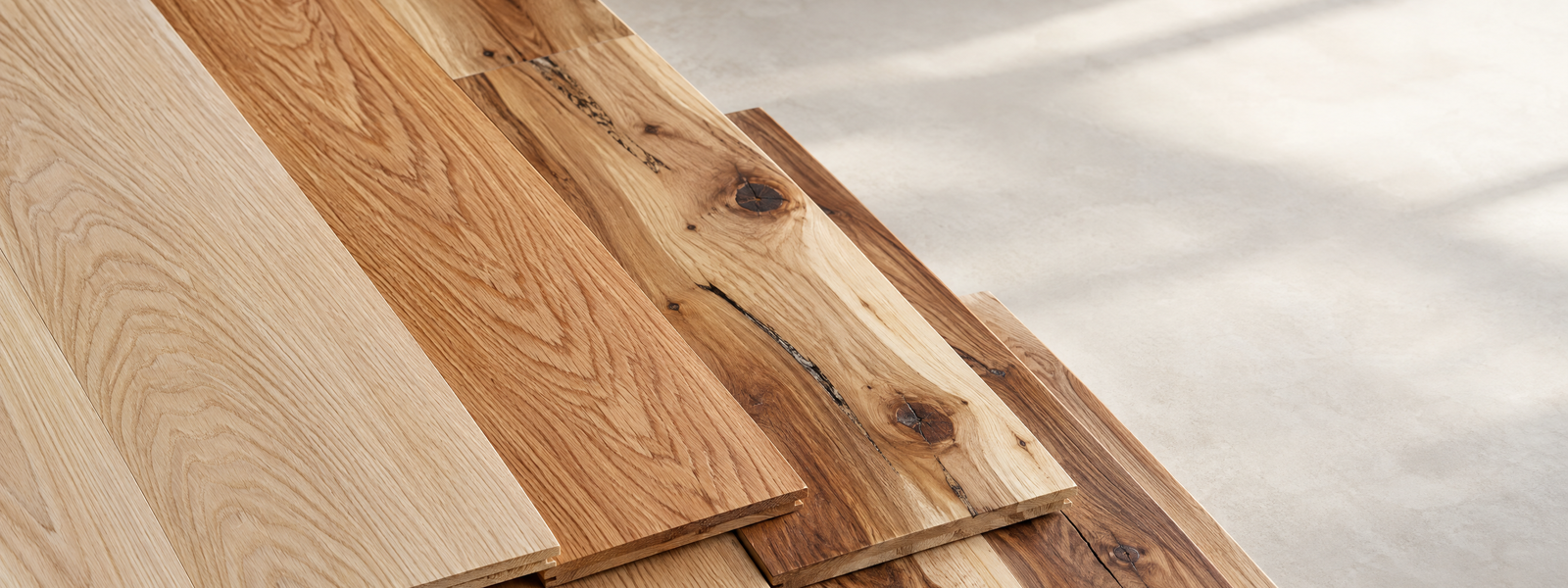
Most homeowners pick a species by looking at a hardness chart, and that is the wrong tool for the job. Janka hardness measures resistance to a single pressing force. It does not measure how a floor looks after five years of a Labrador, a stroller and a Middle Tennessee winter. Grain pattern and grade hide wear far better than hardness does, which is why a red oak floor at 1,290 lbf often looks better at year ten than a harder maple floor at 1,450 lbf.
That is the single most useful thing we can tell you before you start shopping, and it runs against most of what you will read online.
Here is how to actually choose.
The Janka test measures the force required to embed a steel ball halfway into a wood sample. It is a legitimate number and it is worth knowing.
What the number does not tell you is how visible a dent will be once it happens. Every floor in a lived-in house gets dented. The question is whether you see it from the doorway.
Hard maple is a good example. It is harder than red oak, but its grain is tight, pale and uniform, so a dent or a scratch reads as a dark line against a smooth field. Red oak is softer, but its open, busy grain and natural color variation absorb small damage visually. Hickory is the hardest of the domestic options at 1,820 lbf and also has the most dramatic color swing from board to board, which is why it performs so well in houses with dogs and kids.
If your priority is a floor that still looks good in a decade, weight grain and color variation more heavily than the hardness number.
No. Grade describes appearance, not structural quality or durability. A No. 2 Common board and a Clear board come from the same tree species, are milled the same way and are equally sound underfoot. What separates them is how much natural character the board is allowed to show.
The standard grades run roughly like this:
The queries we see coming into the Gallatin showroom include things like unfinished character grade red oak, and that is a real and growing preference. The farmhouse and modern rustic looks that dominate new construction around Gallatin and Hendersonville are built on No. 1 and No. 2 Common oak.
One customer summed up the tradeoff well in a review of a project we did, describing grade 2 hickory with a lot of color and knots. That is exactly what the grade delivers, and it is exactly what you should want if that is the look you are after.
The cost catch: lower grades cost less per square foot but require a larger waste allowance, because you will cull boards you do not want in visible areas. Budget the material savings and the extra waste together, not separately.
Red oak is the workhorse of this region and the easiest to match into existing floors, which matters enormously in Gallatin and Nashville homes that already have oak somewhere. It takes stain predictably and it is widely available in every grade.
White oak has a tighter grain, a cooler undertone and takes the gray and greige stains that have dominated the last decade far better than red oak does. It is slightly harder and generally costs more.
Hickory is the durability pick. At 1,820 lbf it is the hardest common domestic flooring species, and its dramatic light to dark variation hides everything. It is less forgiving to stain evenly, so many hickory floors look best with a clear or natural finish.
Hard maple gives you the cleanest, most contemporary look of the domestic species. It is beautiful and it is the least forgiving. It blotches when stained without proper conditioning, and it shows wear against its uniform surface.
Black walnut is the softest of this group at 1,010 lbf, and it is stunning. Rich chocolate tones, no stain required. It belongs in a formal dining room or a primary suite, not a mudroom.
Exotics like Brazilian cherry, tigerwood, acacia and teak run harder still, and they require extended acclimation before installation. We manage that process carefully, because exotic species that go down too fast are the ones that warp and gap later.
This is where a lot of projects go sideways. People choose a species from a photo, then choose a stain from a different photo, and the combination does not exist.
Red oak has a pink undertone that fights cool gray stains. White oak does not. Maple resists penetration and can blotch. Hickory's natural color variation means a dark stain reduces contrast while a light one amplifies it.
The only reliable method is sampling on the actual floor, with the actual species, in the actual room light. We do on-floor sampling and custom color blending for exactly this reason, and it is a step worth insisting on regardless of who installs your floor. A four inch stain sample on a piece of scrap tells you very little about a 1,200 square foot room.
If you are adding a room, refinishing part of a house, or replacing a damaged section, species and grade are not really your choice anymore. The existing floor decides. Matching species, grade, board width and stain to what is already there is the whole job, and getting it wrong is obvious to everyone who walks in.
This is one of the things customers come to us for repeatedly. One long-time customer noted we were the only company willing to take the time to find flooring that matched an existing floor in their home. That is not a species decision. That is a sourcing and finishing problem, and the answer is often a material you would not have picked from a catalog.
Similarly, if your budget is tight, grade is the lever, not species. Moving from Select to No. 1 Common red oak saves real money and, in a rustic or farmhouse design, looks better. Moving from oak to a cheaper species rarely saves as much as you expect once installation is priced in.
Is hickory too busy for a whole house?It can be in a small, formal space. In an open plan with good natural light, hickory's variation reads as warmth rather than noise. The best test is a large sample laid out in your own room across several hours of light.
What is the most durable hardwood floor for dogs?Hickory, for the combination of high hardness and heavy grain variation that camouflages scratches. A matte or satin finish helps more than the species does, because gloss finishes reflect light off every scratch.
Does character grade flooring cost less?The material costs less per square foot, but you should budget extra waste because you will set aside boards you do not want in prominent areas. The net savings are real but smaller than the price difference suggests.
Can I mix hardwood species in one house?Yes, if you break at a natural transition such as a doorway or a stair landing. Mixing species within one continuous sight line rarely works. Mixing grade within one room never works.
What is the best hardwood for a wide plank floor?White oak and hickory both hold up well in wide formats. For any plank above about 5 inches, construction matters as much as species, and engineered construction is worth serious consideration.
Should I choose unfinished or prefinished for an unusual species?Unfinished gives you far more control with species that stain unpredictably, such as maple and hickory. Prefinished limits you to what the factory offers but eliminates on-site finishing time.
Photographs lie about wood. Screens lie about color. The showroom exists because this is a decision you make with your eyes and your hands.
Copeland Hardwood Floors stocks a broad range of species and grades at 610 Airport Road in Gallatin, and we install solid hardwood, engineered hardwood, unfinished hardwood and exotic species across Gallatin, Hendersonville, Nashville, Brentwood, Franklin, Mt. Juliet, White House, Lebanon, Bethpage, Millersville, Madison and Goodlettsville.
Call (615) 451-0723 or contact us to schedule a showroom visit or a free estimate. Beauty That Lasts a Lifetime.
Related reading: Engineered vs. Solid Hardwood in Gallatin and Stain and finish options.