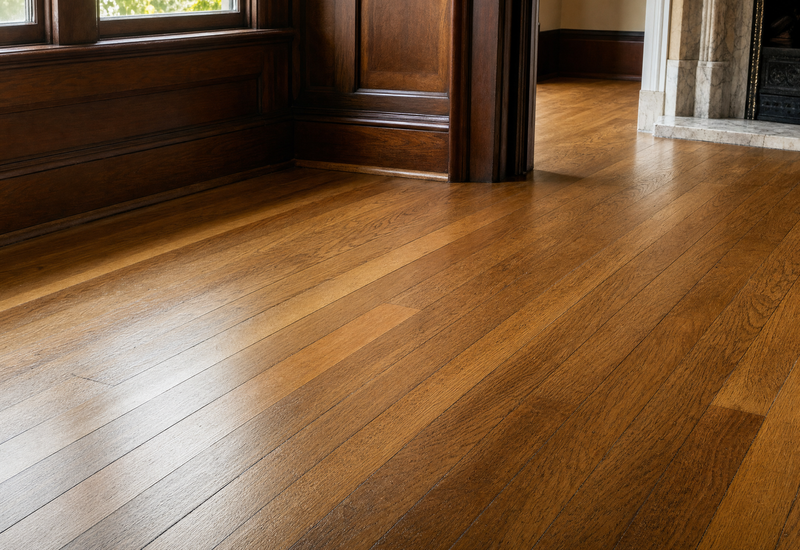
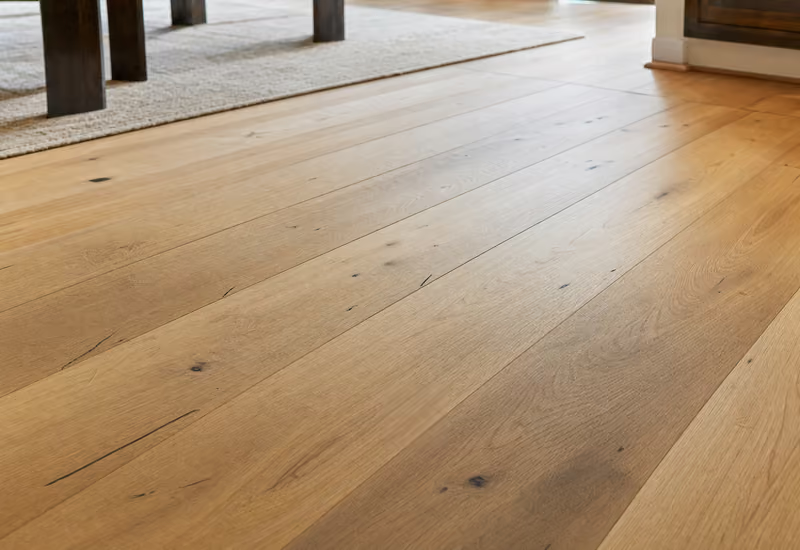
Prefinished floors install faster. Site-finished floors seal flat and last longer. A Gallatin flooring contractor explains the bevel nobody mentions.
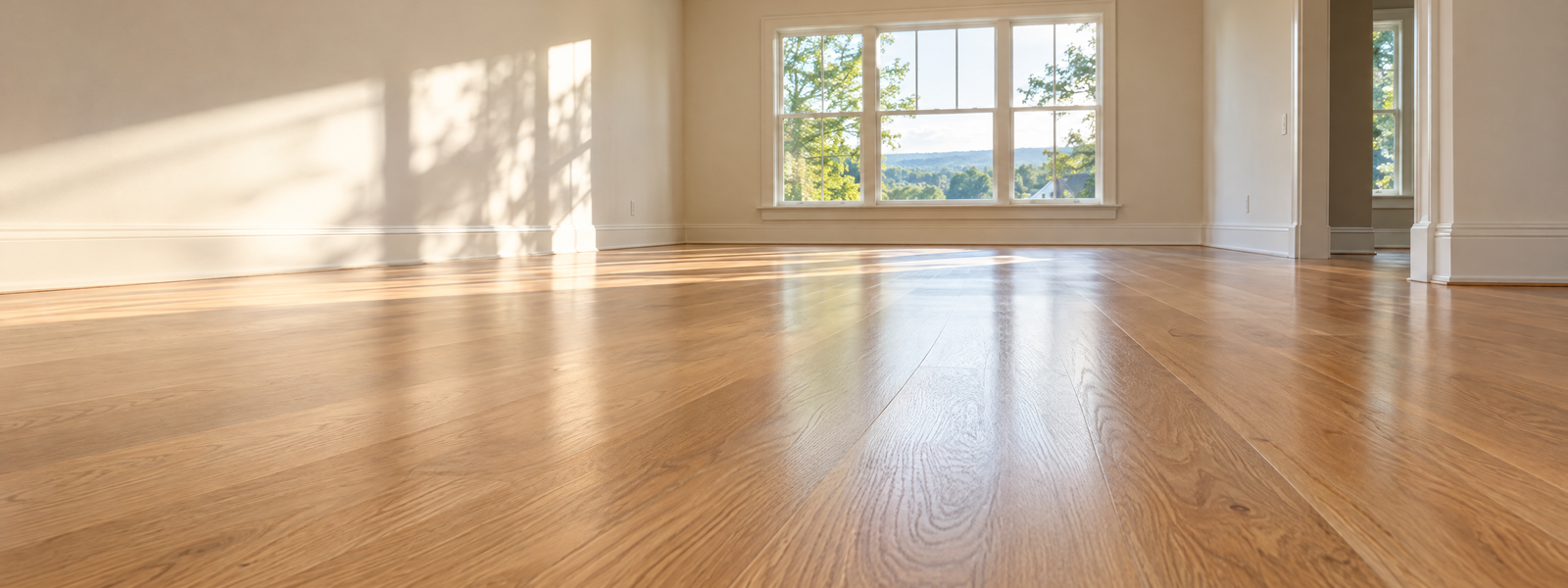
Choose prefinished hardwood when you are living in the house during the project and need to walk on the floor the day it goes down. Choose site-finished hardwood when you want a perfectly flat, seam-sealed floor and a stain color that does not exist in any catalog. The tradeoff nobody explains is the bevel: nearly every prefinished board has a small groove milled along its edges, and that groove is permanent.
Both approaches produce a beautiful floor. They produce different floors, and the difference shows up in ways that are hard to see in a showroom and impossible to undo later.
Prefinished hardwood arrives at your house already stained and sealed. The finish was applied in a factory under controlled conditions, cured with equipment no contractor owns, and inspected before it shipped. Installation is the last step. When the last board goes in, the floor is done.
Site-finished hardwood, sometimes called custom site-finished, arrives raw. We install it, then sand the entire floor flat as one surface, then apply stain and multiple coats of finish in your home. The finish flows across the seams between boards rather than stopping at each edge.
That single structural difference drives everything else.
Because factory finished boards are sealed individually before they are ever laid, the manufacturer cannot guarantee that two adjacent boards will sit perfectly flush. Subfloors are not perfect. Boards vary slightly in thickness. So the factory mills a small chamfer along each edge, called a micro-bevel or an eased edge, that disguises any height difference between neighbors.
You get a floor with a visible line at every board seam. Many people like that look, and it is the defining characteristic of most prefinished flooring.
What people do not anticipate:
Site-finished floors have no bevels. The surface is continuous, the seams are sealed by the finish itself, and damage can be sanded and recoated in place.
Prefinished is faster, and that is its strongest argument. The floor is finished the moment the last board is set. For a family staying in the house, a rental turnover, or a project with a hard deadline, that matters more than any aesthetic debate.
Site-finished work adds sanding, stain application and multiple finish coats, plus drying time between coats. The floor is walkable before it is fully cured, and full cure takes longer still. During cure, you can walk on the floor but you should hold off on rugs and heavy furniture, because both can trap solvent and mar a finish that is not yet at full hardness. We give every customer a specific schedule for their finish system rather than a generic number, because waterborne, oil-based and hardwax oil finishes all behave differently.
Less than it used to be, and less than most people expect. Our dustless system captures 99% of dust at the source using professional-grade sanders connected to high-powered vacuum containment units.
One Gallatin homeowner who had us replace carpet with hardwood in two bedrooms put it plainly in a review: the process was not nearly as messy as expected, and there was more dust from pulling up the old carpet than from sanding the hardwood.
The honest caveat is that dustless refers to dust collection at the sander, not the elimination of every particle from a construction site. There is still odor from finishes, there is still equipment in your house, and there are still days you cannot use the room. A good crew mitigates all of that. One customer noted that our team covered areas of the house with protective sheeting and removed wall decorations before sanding, without being asked. That is the standard, and it is worth asking any contractor how they handle it.
We install both, and we push people toward prefinished more often than you might expect.
Choose prefinished when:
Choose site-finished when:
Sometimes the right move is not to install new flooring at all. If your existing hardwood is structurally sound and simply looks tired, refinishing what you have costs less and produces a better result than covering it. A refinishing cycle can extend a floor's life by 10 to 20 years, and if the floor only needs gloss restored rather than color changed, a screen and recoat is faster and cheaper still.
We would rather tell you that up front than sell you a floor you did not need.
Does prefinished hardwood last as long as site-finished?The wood lasts the same. The finish on prefinished flooring is typically harder and lasts longer before needing attention. Site-finished floors are easier to renew when that time comes, because they can be sanded and recoated without the bevels limiting how flat the surface can get.
Can you refinish a prefinished floor later?Yes, if it is solid wood or engineered with a sufficient wear layer. The result will not be identical to a site-finished floor, because the milled bevels remain visible along the board edges after sanding.
How long before I can move furniture back?Walking is usually possible well before the finish is fully cured. Heavy furniture and area rugs should wait longer, and the exact timeline depends on the finish system used. We provide a written schedule for your specific project.
Is site-finished flooring more expensive?Material for unfinished flooring generally costs less, and labor costs more because sanding and finishing happen on site. Total project cost tends to land close together, with site-finished slightly higher for comparable species and grade.
Do low-VOC finishes really smell less?Yes, noticeably. Modern waterborne and low-VOC systems have far less odor and dry faster than traditional oil-based finishes. They are not odorless, and anyone with genuine chemical sensitivity should plan to be out of the house during application.
Which one is better for a home with pets?Prefinished aluminum oxide finishes resist scratching best. If a dog does eventually mark the floor, site-finished flooring is far easier to repair invisibly. Choose based on whether you would rather prevent damage or fix it.
Copeland Hardwood Floors installs prefinished hardwood, unfinished hardwood and custom site-finished floors, and we run dustless refinishing and sand finishing throughout Middle Tennessee. Visit the showroom at 610 Airport Road in Gallatin to see both in person.
We serve Gallatin, Hendersonville, Nashville, Brentwood, Franklin, Mt. Juliet, White House, Lebanon, Bethpage, Millersville, Madison and Goodlettsville.
Call (615) 451-0723 or contact Copeland Hardwood Floors for a free estimate. Beauty That Lasts a Lifetime.
Related reading: Engineered vs. Solid Hardwood in Gallatin, Choosing a Hardwood Species and Grade, and Do Your Hardwood Floors Need Refinishing? 7 Signs to Look For.