Where to buy hardwood flooring near Gallatin, and how much to order. Waste factors, grade, acclimation and the trim mistake that costs DIYers a second trip.
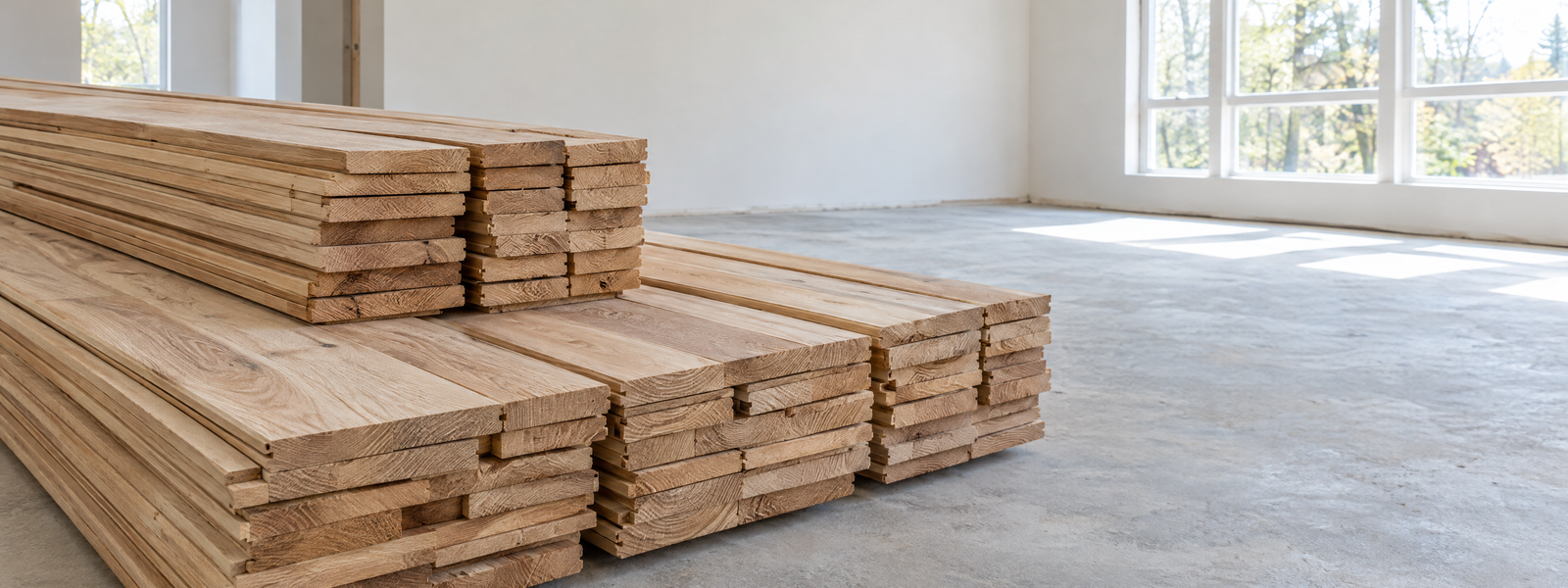
You can buy hardwood flooring material without hiring an installer, and in Gallatin you can buy it from a flooring company rather than a big box store. The difference is not price. It is that a flooring supplier can tell you the grade, the moisture content and the mill run of what you are buying, hold material for acclimation, and sell you matching trim and flush-mount vents from the same lot. Those three things are what separate a floor that goes down clean from a weekend that turns into a month.
We sell material cash and carry out of the showroom at 610 Airport Road in Gallatin, to homeowners doing their own work and to builders and contractors working across Sumner, Davidson, Wilson and Williamson counties. Here is what we tell people before they load a truck.
This is where most DIY projects go wrong, and it is entirely avoidable.
Start with the square footage of the room, then add a waste allowance on top. The allowance depends on two things: how you are laying the floor, and what grade you bought.
Then add a little beyond that for the floor's future. Wood is milled in lots, and lots vary. Boards from a different lot two years from now will not match perfectly. Keeping a few extra bundles in a dry closet is the cheapest floor repair insurance available, and every homeowner who ever dropped something heavy has wished they had done it.
Ordering short is not a small inconvenience. It means waiting on a reorder, and it often means a visible color break where the second batch begins.
Four things, and none of them appear on a price tag.
Grade you can verify. Hardwood flooring is graded by appearance: Clear, Select, No. 1 Common and No. 2 Common. A box labeled "oak flooring" tells you nothing about which of those you are getting. Grade drives both the price and the look, and it determines your waste factor. You should know what you bought.
Moisture content that matches where the wood is going. Flooring that has been sitting in an unconditioned warehouse or a garage is not at the moisture content of your living room. That mismatch is the number one cause of gapping in a floor's first winter.
Trim, vents and transitions from the same material. Flush mount wood vents, baseboards, shoe molding, stair nosing and transition pieces should come from the same species and ideally the same run as the floor. This is the detail DIYers forget until the floor is down and the vents look wrong. We keep custom trim, baseboards and moldings alongside the flooring for exactly this reason.
Someone to call when something is odd. If a bundle looks different from the rest, or a board will not sit flat, or the subfloor reads high on a moisture meter, you want a person who installs floors for a living on the other end of the phone.
Long enough to reach equilibrium with the room it is going into, which is a condition, not a fixed number of days.
Acclimation means bringing the material into the actual house, at normal living temperature and humidity, and letting it stabilize before you install. The house needs to be at normal conditions too. Acclimating flooring inside a construction site with no HVAC running accomplishes nothing.
The National Wood Flooring Association recommends an interior environment of 30 to 50 percent relative humidity and 60 to 80 degrees Fahrenheit for wood floors to perform. That is the target the material should be equalizing to.
Exotic species take longer. Brazilian cherry, tigerwood, acacia and teak all need extended acclimation, and rushing them is how you get warping and gapping after installation.
The practical version: stack the bundles in the room where they are going, cross-stack or open them so air reaches the boards, run the HVAC as you normally would, and check moisture content with a meter rather than counting days on a calendar.
Different problem, same fundamentals. The contractors who buy from us are usually solving for schedule and consistency rather than for a single room.
What matters on that side: knowing whether a species and grade can be sourced in the quantity a job needs, on the timeline the job has; being able to get matching material for a change order without a lot break; and having a place twenty minutes away rather than a freight delay when something runs short on a Friday.
We work with distributors including BPI, Jeffco Flooring, Middle Tennessee Lumber and Tennessee Wood Flooring, and we carry raw hardwood, prefinished planking, flush vents and trim. If you are running work across Gallatin, Hendersonville, Nashville and Williamson County, being able to pick up rather than wait is often worth more than a per foot difference.
Here is the part a supplier is not supposed to say.
Do not DIY a nail-down solid floor over a subfloor you have not tested. A moisture meter costs less than one room of flooring. If the subfloor reads high, no installation technique saves you.
Do not DIY over a concrete slab without understanding vapor barriers. Slab moisture migrates for years. Glue-down and floating installations over concrete have specific requirements, and getting them wrong shows up as cupping a year later, long after the material is paid for.
Do not DIY a floor you intend to sand and finish yourself. Renting a drum sander and learning on your own living room is the single most expensive mistake in this category. Sanders remove wood fast, and the marks a beginner leaves show up permanently under finish. This is the one step where hiring out is almost always cheaper than doing it over.
Do not DIY matching into an existing floor. Sourcing material that matches an older floor's species, grade, width and color is a sourcing and finishing problem, not a shopping problem. It is the request we hear most often from people who tried elsewhere first.
Do not DIY if the room is more than one continuous rectangle, at least not for your first project. Transitions, thresholds, stair nosings and closet returns are where amateur installations look amateur.
Buying material and installing a straightforward bedroom or an office yourself is very achievable. Buying material for a whole first floor with a stair landing and no prior experience usually is not.
Can I buy hardwood flooring without hiring an installer?Yes. We sell material cash and carry from the Gallatin showroom to homeowners and to trade customers, including raw hardwood, prefinished planking, flush mount vents and trim.
How much extra flooring should I order for waste?Plan on roughly 5 to 10 percent above your square footage for a straight lay in a higher grade, more for character grades where you will cull boards, and 15 percent or more for diagonal or herringbone patterns. Order a little beyond that to keep for future repairs.
Does hardwood flooring need to acclimate before installation?Yes. Bring it into the room where it will be installed, with the HVAC running at normal living conditions, and let it reach equilibrium before installing. Check with a moisture meter rather than assuming a fixed number of days.
Can you help me pick material even if I am installing it myself?That is a large part of what the showroom is for. Come in with your room dimensions, your subfloor type and a photo of any existing flooring you need to match.
Do you sell matching vents, trim and baseboards?Yes. Flush mount wood vents, baseboards, moldings and trim are available alongside the flooring, which is the right way to buy them. Matching them later is much harder than matching them up front.
What if I start the project and get in over my head?Call us. Taking over a partially completed installation is a normal request, and it is far easier to fix at board fifty than at board five hundred.
The showroom at 610 Airport Road in Gallatin is open to homeowners, DIYers, builders and contractors. Bring your dimensions and a photo of the room, and we will help you figure out what to buy and how much of it.
We supply and install across Gallatin, Hendersonville, Nashville, Brentwood, Franklin, Mt. Juliet, White House, Lebanon, Bethpage, Millersville, Madison and Goodlettsville.
Call (615) 451-0723 or contact Copeland Hardwood Floors. Beauty That Lasts a Lifetime.
Related reading: Choosing a Hardwood Species and Grade in Middle Tennessee, Prefinished vs. Site-Finished Hardwood, and Why Hardwood Floors Cup and Gap in Middle Tennessee.