Engineered hardwood is real wood. The number that matters is wear layer thickness, and it separates a 20-year floor from a 100-year floor at the same price.
Quick answer: Engineered hardwood is real hardwood. The top layer is solid wood from the same tree species as a solid floor, bonded to a multi-ply core that resists seasonal movement. The word "engineered" tells you almost nothing useful. The number that matters is the wear layer thickness, and it ranges from about 1mm to 4mm or more. A 1mm wear layer can never be sanded and lasts roughly 20 to 30 years. A 4mm wear layer can be refinished three to five times and lasts 50 to 100 years or more. Both are sold as "engineered hardwood." Ask for the millimeters before you ask about anything else.
That single spec is the difference between a floor your grandchildren sand down and restain, and a floor that gets replaced before your mortgage is paid off. It is rarely printed on the sample board.
Here is what engineered hardwood actually is, when it beats solid wood in a Middle Tennessee home, and when it does not.
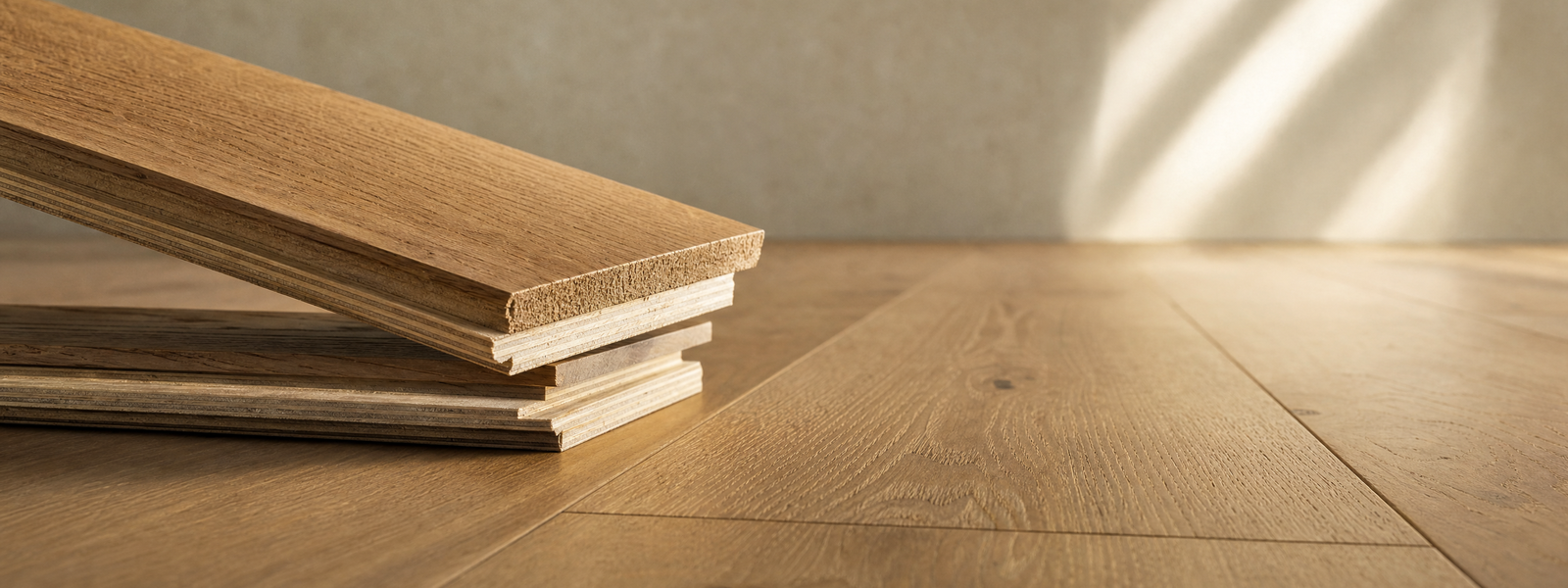
Picture a plank cut in half. The top is a layer of genuine hardwood: white oak, hickory, walnut, maple, whatever species you chose. Beneath it sits a core of multiple thin wood plies, each layer laid at an angle to the one below.
That cross-layered core is the entire point. Solid wood expands and contracts across its width as humidity changes. In an engineered plank, each ply pulls against the plies above and below it, so the assembly stays dimensionally stable when the air changes.
The surface you walk on, sand, and stain is real wood. Underfoot, it looks and feels identical to a solid floor, because the visible part is a solid floor. What is different is what happens in the two inches you cannot see.
Engineered is not laminate, and it is not luxury vinyl plank. Laminate is a photograph of wood under a wear coat. LVP is plastic. Engineered hardwood is wood. People conflate the three constantly, and it costs them either money or a floor they did not want. For an honest material comparison, see hardwood versus luxury vinyl plank.
This is the part worth printing out and taking with you.
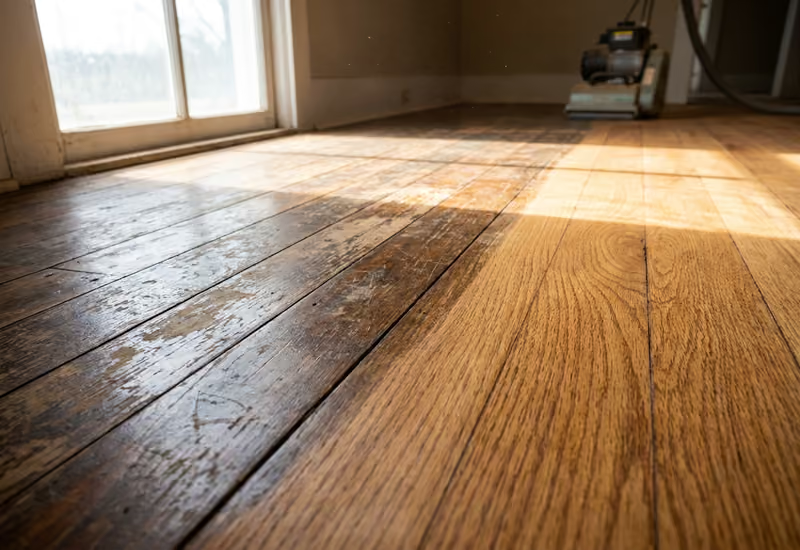
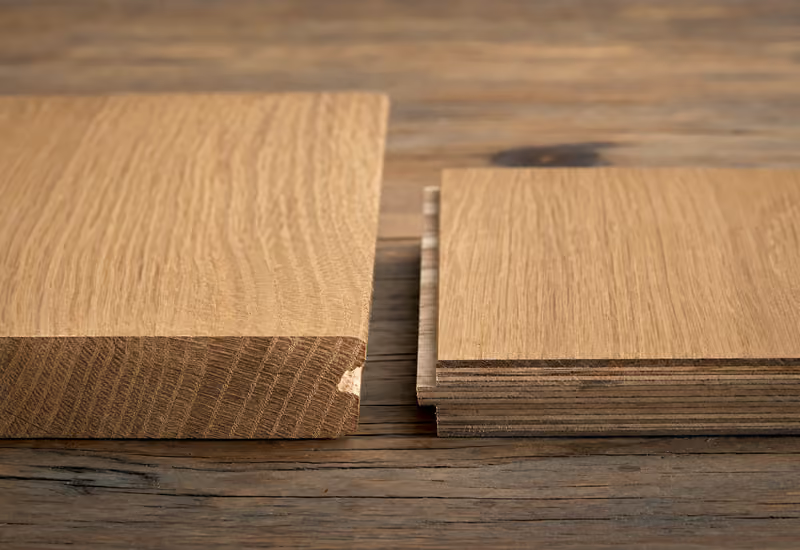
Each refinishing removes a small portion of the wear layer. Once you sand through it, you hit the plywood core, and the floor is finished for good. A 4mm sawn-face wear layer can be sanded about as many times as a standard 3/4-inch solid floor. Learn how solid hardwood compares when your home has a wood subfloor above grade.
Why this matters more than the price tag. Two engineered floors can look identical in the showroom and carry similar prices while one has a 1mm wear layer and the other has 4mm. Over thirty years those are not the same purchase. The thin one is a finished good with an expiration date. The thick one is an asset you maintain.
When you shop, the questions are: how many millimeters is the wear layer, and is the face sawn or sliced rather than rotary peeled? Any supplier who cannot answer the first question quickly is not a supplier you want.
We install both. These are the situations where engineered is not a compromise but the better technical answer.
Over a concrete slab. Solid hardwood does not belong glued or nailed directly to concrete. Engineered does. If your Gallatin home is slab-on-grade, and a great many newer ones are, engineered is how you get a real wood floor at all.
In a basement or below grade. Same reason. Moisture moves up through concrete, and solid wood responds badly to it.
Over radiant floor heat. Many modern radiant systems are compatible with engineered hardwood and are not compatible with solid. The heating cycle drives moisture out of wood repeatedly, and the layered core tolerates that where a solid plank cups or gaps.
Where humidity swings hard. Middle Tennessee averages around 70% relative humidity outdoors across the year, and indoor humidity swings much further than that once heating and air conditioning enter the picture. A stable core absorbs that stress better than a solid plank does.
In wide planks. The wider the board, the more it moves. A 7-inch solid plank has a lot more width to expand across than a 3-inch one. Wide-plank looks are much safer engineered.
Whichever we install, the preparation is the same and it is not optional: moisture testing of the subfloor, vapor barriers or moisture-retardant adhesives where the readings call for them, and subfloor leveling so the floor lies flat. Most engineered floor failures are preparation failures, not product failures.
We would rather say this plainly than sell you the wrong product.
You want a floor that outlives several owners and you have a wood subfloor above grade. A 3/4-inch solid floor can be sanded many times over a century. It is still the benchmark.
You want a fully custom color. Site-finished solid wood lets you sand, stain, and finish in place, which means you can match anything and change your mind about sheen. Prefinished engineered locks in the factory's decision. Review the practical differences in prefinished hardwood floors before choosing a product.
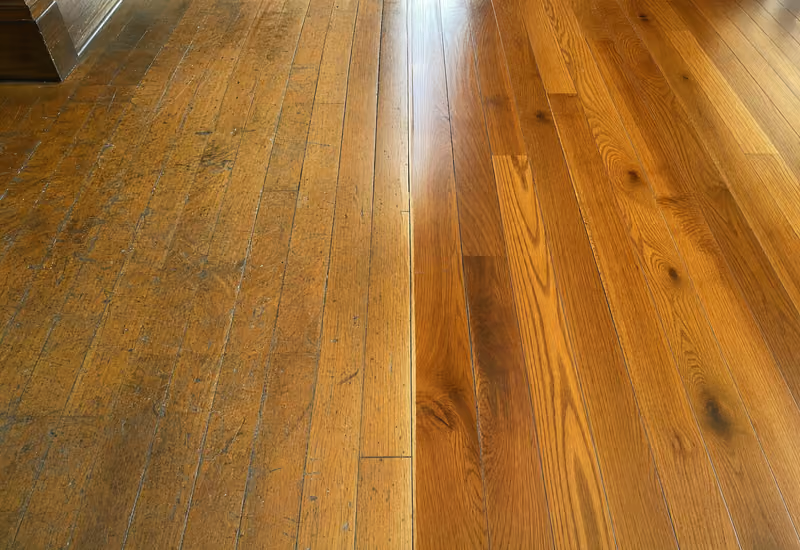
You are matching an existing solid floor. Blending new engineered planks into an old solid floor is possible but harder. If you are extending hardwood into another room, solid is usually the cleaner path.
Your budget only reaches a 1mm or 2mm wear layer and you plan to stay put for decades. In that case a modest solid floor often beats a thin engineered one on lifetime value.
Worth a quick note, because it confuses local search. "Engineered Floors" is also the name of a flooring manufacturer. If you searched that phrase and landed here looking for a specific brand rather than the product category, we can still help you compare what is actually available in Gallatin, including engineered hardwood from the suppliers we work with.
Is engineered hardwood real wood?
Yes. The top layer is genuine hardwood of the species you choose, bonded to a multi-ply wood core. It is not laminate, which is a printed image, and it is not luxury vinyl plank, which is plastic. Underfoot it looks and feels the same as solid hardwood because the surface is solid hardwood.
How many times can engineered hardwood be refinished?
It depends entirely on the wear layer. A 1mm wear layer cannot be sanded at all and can only be recoated. 2mm allows one or two refinishings, 3mm allows two or three, and 4mm or thicker allows three to five. Ask for the millimeter figure before you compare prices.
Is engineered hardwood better than solid hardwood?
Neither is better in general. Engineered is the right answer over concrete slabs, below grade, over radiant heat, and in wide planks. Solid is the right answer above grade on a wood subfloor when you want maximum refinishing life or a fully custom site-applied color.
Can engineered hardwood go over a concrete slab?
Yes, and this is one of its main advantages. Solid hardwood should not be installed directly over concrete. Engineered can be, provided the slab is moisture tested and a vapor barrier or moisture-retardant adhesive is used where readings call for it.
Does engineered hardwood handle humidity better?
Generally yes. The cross-layered core resists the expansion and contraction that causes solid planks to gap in winter and cup in summer. It reduces movement rather than eliminating it, so indoor humidity control still matters.
How long does engineered hardwood last?
Anywhere from 20 to more than 100 years, driven almost entirely by wear layer thickness and installation quality. That range is why the specification matters more than the category name. For broader maintenance context, read how long hardwood floors last.
The fastest way to understand wear layers is to see a cut edge in person. Call Copeland Hardwood Floors at (615) 451-0723 or stop by 610 Airport Rd, Gallatin, TN 37066, and we will show you the difference between a thin wear layer and a thick one, then tell you which one your subfloor and your house actually call for.
We serve Gallatin, Hendersonville, Nashville, Franklin, Brentwood, Mt. Juliet, Lebanon, White House, Goodlettsville, Madison, Millersville, and Bethpage.
Beauty that lasts a lifetime. Request a free quote today.